
For years, remote patient monitoring (RPM) has been sold as the future of proactive, preventive medicine: a blood pressure cuff or pulse oximeter quietly feeding data back to a care team, catching problems before they become emergencies. It's a genuinely good idea. But somewhere between the idea and the invoice, a lot of RPM turned into something else — a billing product.
CMS's 2027 Physician Fee Schedule proposal is a direct response to that drift. While the initial headlines have faded, I think it's worth a closer look, because the underlying issue it's trying to address isn't going away.
What the rule actually does.
Buried in a 1,592-page draft rule (CMS-1848-P) is a change that could reshape the entire remote monitoring industry: starting January 1, 2027, Medicare would only pay for RPM and RTM (remote therapeutic monitoring) services performed by clinical staff who are direct employees of the billing practice — not staff contracted through a third-party vendor.
The staff don't have to sit in the practice's building. They just have to actually work for the practice, under the billing physician's general supervision. That one distinction — employee versus contractor — is enough to unwind an entire cottage industry of vendors who supply both the monitoring software and the call-center nurses who make the required monthly check-in calls.
A few other changes travel alongside this one.
- Before a practice can bill for RPM, a practitioner has to actually see the patient (in person or via telehealth), decide the monitoring is clinically appropriate, and get consent.
- RTM is restricted to established patients, bringing it in line with existing RPM rules.
- CMS wants to consolidate 17 separate billing codes into four bundled G-codes covering setup/education, device supply, data transmission, and treatment management — a move meant to force practices to actually deliver every component of the service, not just the profitable one.
Why CMS is doing this?
The agency's language is pointed. It argues that outsourcing to a vendor "can fragment care, weaken the billing practitioner's involvement," and produce services that skip required elements. In its own words, a vendor with only "a loose association with the treating practitioner can detract from longitudinal, patient-centered care."
That's not a hunch. It's backed by two HHS Office of Inspector General reviews:
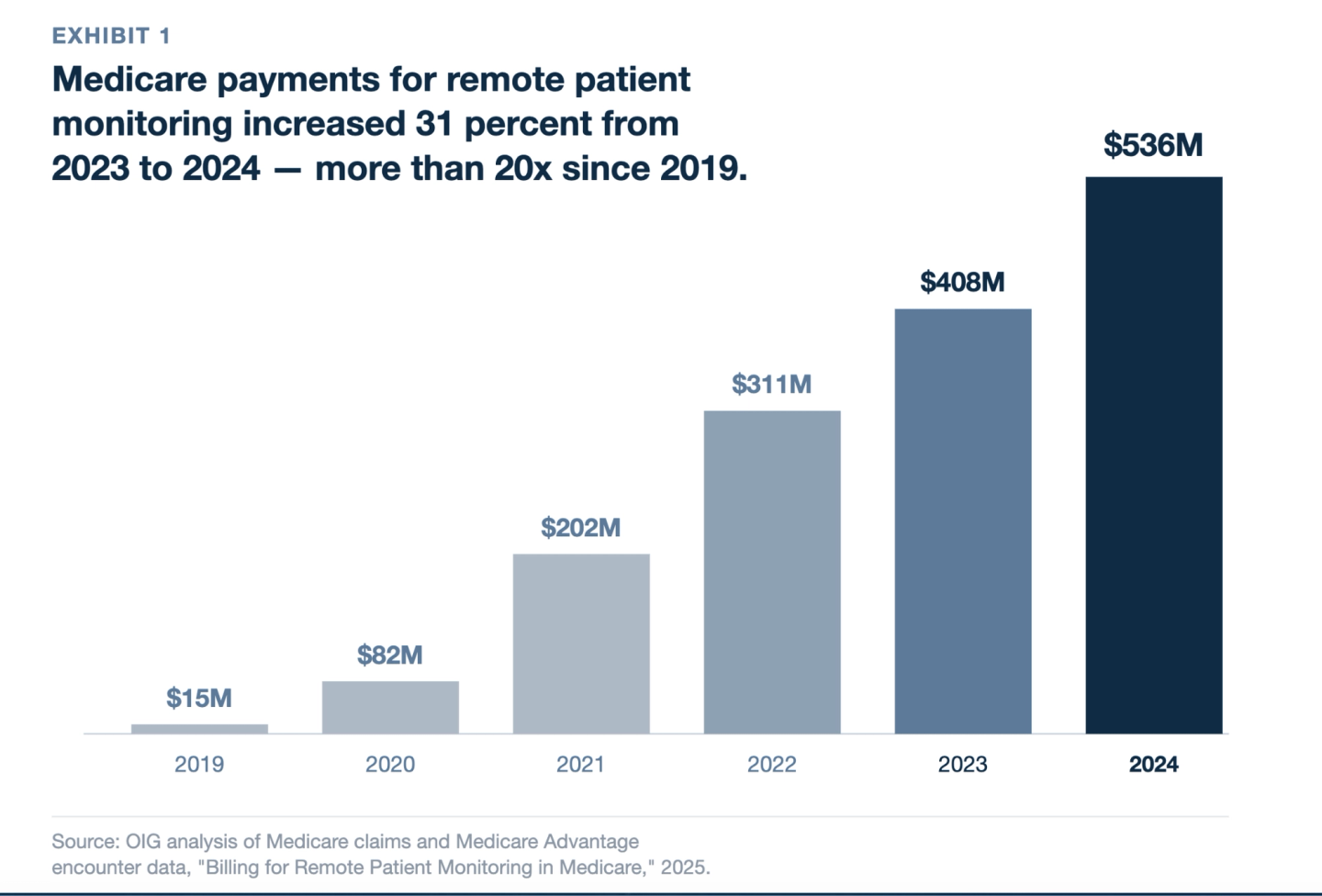
Payments for remote patient monitoring were $536 million in 2024. It represents a 31-percent increase from 2023 and continues an upward trend that has occurred every year since Medicare began widely covering the services in 2019.

A 2025 follow-up found that some practices had no prior medical relationship with more than 80% of the patients they billed for remote monitoring — in one case, over 3,400 enrollees. The OIG was careful to say this doesn't prove fraud, just that it warrants a closer look.
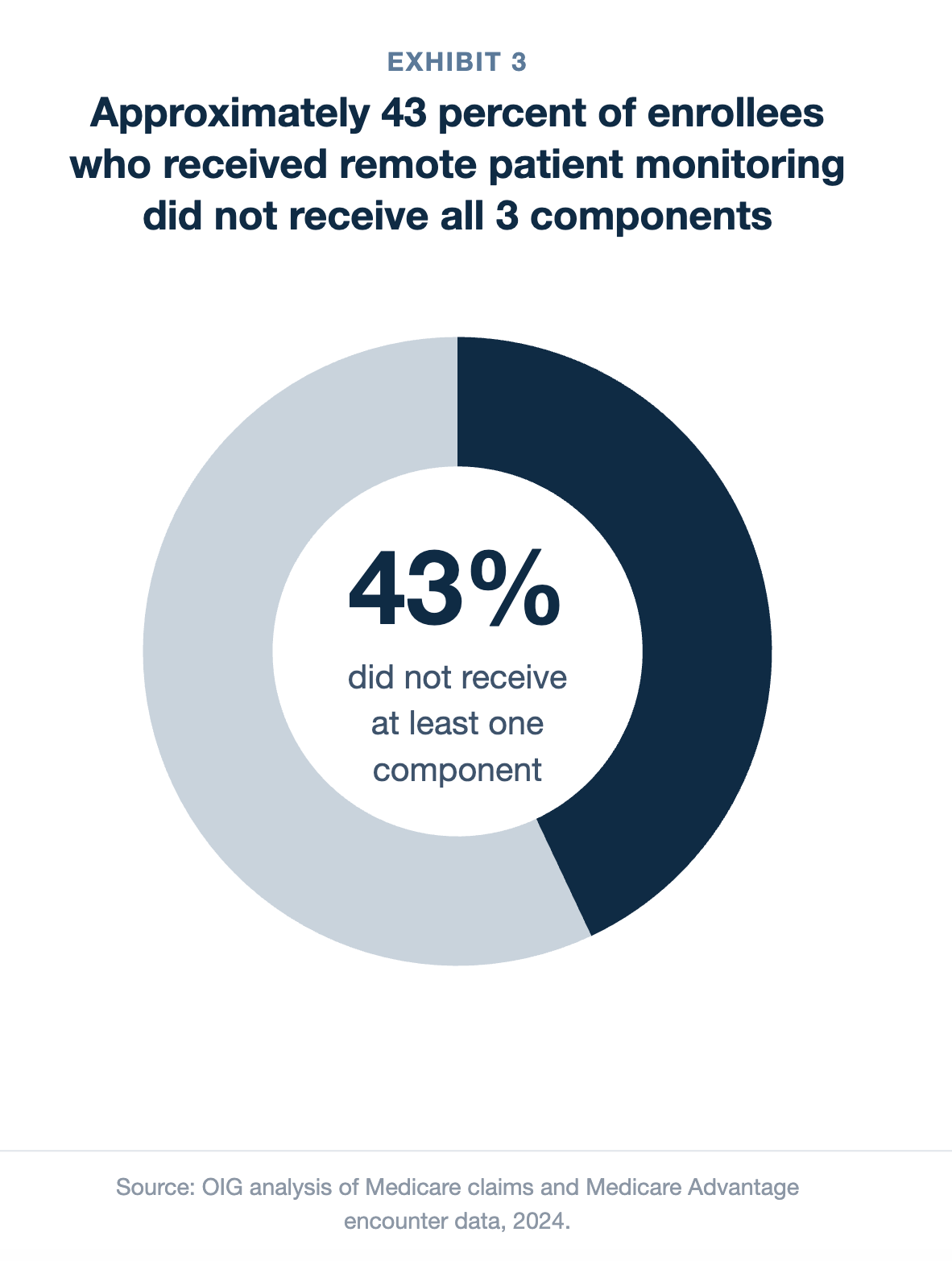
A 2024 review found that 43% of Medicare enrollees who got remote monitoring in 2022 didn't receive all three required components — education/setup, device supply, and treatment management. In other words, nearly half the people billed for "monitoring" weren't getting the full service.
In total, approximately 244,000 enrollees did not have a claim or encounter record for at least one component in 2022. About 113,000 of these enrollees did not have a claim or encounter record for two components. See Exhibit 2. Although CMS does not require that providers bill for all three components, the high percentage of enrollees who did not receive all components raises questions about whether these services are being used properly.
The Industry Pushback
Not everyone sees this as a fix. Christopher Adamec, of the Alliance for Connected Care, argues that most primary care practices — especially small and rural ones — simply don't have the infrastructure, device logistics, or 24/7 staffing to run RPM in-house. Vendors exist, he says, because building that capability from scratch takes years, not the six months practices would have before the rule kicks in. His fear: faced with "build it or kill it," most practices will choose to kill it, and patients who rely on that early-warning monitoring to avoid hospitalization will lose access.
The ATA, the telehealth industry's policy arm, has struck a more cautious tone, saying only that some provisions "may raise concerns or have unintended consequences."
Both are fair points. There's a real access risk here for practices that genuinely set up compliant, well-integrated programs with vendor partners. Will this hurt some practices that were doing this right, especially smaller and rural ones without the resources to build in-house? Almost certainly, at least in the near term.
My advocacy for health equity kicks in here, where I am concerned that RTM in rural or smaller practices, that don’t have resources to change this model by January 1, will just stop the program. I am hopeful the industry will orchestrate a fix for these smaller practices that will still provide monitoring while in compliance with the new rule.
When fee-for-service doesn't incentivize for outcomes then this can happen.
Look at how this program actually came to exist. When CMS created the program back in 2019, it allowed "clinical staff under general supervision" to deliver the monthly management service — a reasonable-sounding flexibility that, in practice, opened the door to an entire cottage industry of RPM vendors supplying software plus a call-center nurse to knock out the required 20 minutes of monthly patient contact.
That's not inherently corrupt. But fee-for-service reimbursement has a gravitational pull, and over a few years that pull turned "remote monitoring" into something that, in too many cases, looks less like clinical care and more like a billing product. The OIG's own numbers make the case better than I can: when 43% of billed patients aren't getting the full service, and dozens of practices are billing tens of thousands of patients they've never actually treated, you're not looking at a monitoring program anymore. You're looking at a reimbursement pipeline with a monitoring-shaped wrapper.
That's the deeper problem with letting FFS incentives run unsupervised: the metric that gets optimized is "can this be billed," not "did this patient's blood pressure actually get managed." A vendor whose entire business model is volume of billable touches has no organic incentive to ask whether the touch changed anything for the patient. CMS's proposed fix — forcing direct employment, requiring an actual clinical relationship before monitoring starts, bundling the codes so a practice can't cherry-pick the profitable piece — is a blunt instrument, but it's aimed at the right target: re-attaching the billing to an actual, accountable clinical relationship.
The question CMS is really asking with this rule isn't "should remote monitoring exist" — it clearly should, the clinical case is sound — it's "should anyone be able to bill Medicare for it without being meaningfully responsible for the patient." Put that way, the answer is obvious, and I think CMS is right to close the loophole even if the reimbursement isn’t specifically tied to clinical outcomes for continuity of care.
This rule won't fix fee-for-service medicine's core incentive problem. But it does something valuable: it closes off the easiest, least accountable version of RPM — the one where a vendor's call center, not a treating clinician, is effectively running a patient's monitoring program. That's a reasonable floor to set while CMS keeps building toward payment models. Such as Advanced Primary Care Management (APCM), which launched in 2025 folds chronic care management, transitional care management, and communication-based services into a single monthly bundled payment rather than time-based line items.
And the 2026 PFS final rule, CMS introduced dual conversion factors — one rate for clinicians in qualifying Alternative Payment Models, a lower rate for everyone else.
That's a real, if blunt, financial nudge toward value-based participation across the fee schedule, RPM/RTM included.
Finally, the ACCESS Model (Advancing Chronic Care with Effective, Scalable Solutions) is a 10-year, voluntary CMS initiative that started July 5, 2026, aimed at improving chronic care for Medicare beneficiaries. Moving away from traditional fee-for-service, it uses Outcome-Aligned Payments (OAPs) linked directly to patient health improvements across key clinical tracks.
There is a lot of commentary going back and forth about this proposed rule and CMS is asking for input. Comments close September 14. If you're a practice, vendor, or patient with a stake in this, that window is worth using to comment now.